
Paul McCartney: The Backwards Traveller and The Boys Of Dungeon Lane - Written By Andrew James
Updated: Jun 9
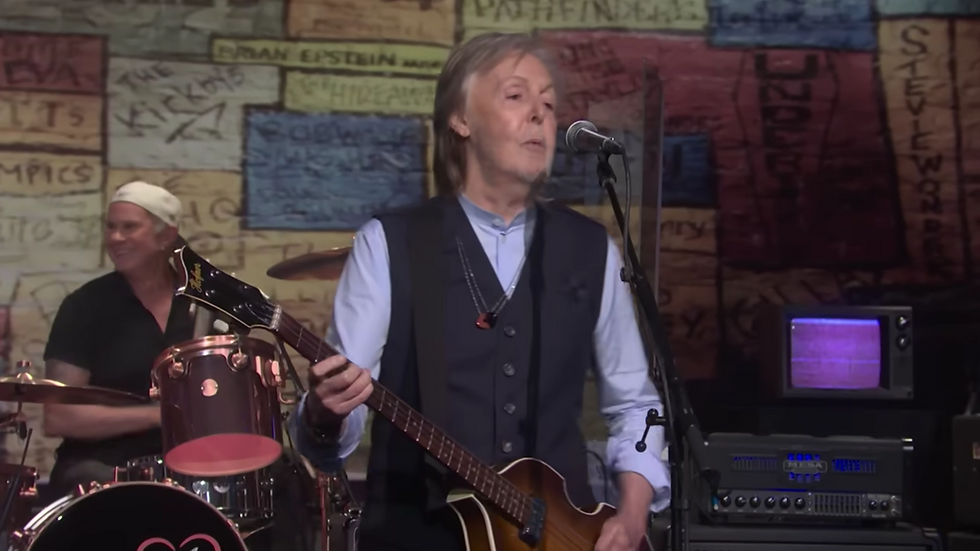
Written by special guest author Andrew James on Paul McCartney's new album, 'The Boys of Dungeon Lane'.
Time is a funny thing for humans. In essence, time is only a concept. A man-made construct. It is something we endeavor to measure to help create structure around our lives. We believe it to be a fixed construct but in reality it is something relative. Both our own perspectives along with the forces of the universe can alter time. The passage of time can be perceived differently by different people. Time is relative to our perception of the present.
Do you feel like sometimes the years go by quicker as you get older? Do you find it seems to take longer when you watch a pot of water come to boil as opposed to doing something else while you wait?
Regardless of how we as humans perceive time, there are some universal truths. The time we have in corporeal form is limited. This is inescapable. But it isn’t impossible to play with time within this framework. We can strive to ‘make the most’ of the time we have. We can ‘waste’ time. We can obsess over time or we can ignore it. We can be taken to the past through memories. We can relive events in the past and pretend they are in the now. We can even contemplate the future where the concept of time continues but the events of such time are not known.
Paul McCartney seems to have time on his mind a lot lately. The elder statement of music and ex-Beatle has circled the sun 83 times now. With lots of time to reflect upon, Paul wants to tackle the construct of time and turn it into something else. He’s used it as a platform for his new 2026 album The Boys Of Dungeon Lane. Time is “a rich place to mine for ideas,” McCartney muses while talking to ‘Mojo’ reporter Grayson Haver Currin for his May 14, 2026 article. Paul sure has a lot of good life moments in the past to reflect on but there have also been some tough times too. He seems to take both in stride and accepts that both good and bad help balance a life. McCartney openly welcomes music’s ability to whisk him and the listeners away to new places. “I hope it transports you,” he endeavors in his May 29, 2026 Facebook post. “Music; it can surprise you and suddenly take you somewhere where you think, ‘wow, I love being in this place.’”
McCartney has spent the last several years working on his new album since 2020’s McCartney III. His dedicated work with producer Andrew Watt stretched back to 2021. Paul would work in sessions with Watt between his touring schedule. Paul got to know Watt on a recommendation from Ronnie Wood of The Rolling Stones. Watt had recently produced the sessions that would generate both the Hackney Diamonds (2023) album and now the upcoming Foreign Tongues (2026) for The Rolling Stones.
Perhaps the songs themselves technically stretches back even further than 2021. As he relayed to Howard Stern in a December 15, 2020 interview, Paul has “an iPhone full” of demos and sound sketches collected from phone recordings over time. He culled a set of songs from this horde for use on this new album with a few new ones sprinkled in. Additionally, one song borrows lyrically from an unused 1991 tune.
Paul has assembled fourteen complete songs (no intro, outros or reprises) compacted into a fairly tidy 47 minutes and change.
As You Lie There
Lost Horizon
Days We Left Behind
Ripples in a Pond
Mountain Top
Down South
We Two
Come Inside
Never Know
Home to Us
Life Can Be Hard
First Star of the Night
Salesman Saint
Momma Gets By
“As You Lie There” is one of the newest songs in the set borne out of the initial meeting between McCartney and Watt at the producer’s studio. McCartney hit on a “wonky chord” as he described it to Laura Barton of The Guardian in her May 29, 2026 article. “It’s a little bit of strangeness. A Little bit of romance. Stranger than fiction.” The mesmerizing rocker developed from there. Paul continued to hit on that theme as the song developed into a story about a secret crush he had as a youngster. Every time he passed by her window, he wondered if she even knew he existed. It turns out this is a true story and the boy is Paul. Paul quickly opened the album by looking back to a story from his past. Curiously Paul wrote the lyrics in the present tense, silently speaking to the girl across the ether, still wondering if she ever noticed him.
“Lost Horizon” centers on sound as a trigger for memory. The song itself, not too unlike its namesake, is a bit of a lost memory itself. Paul had demoed the song some 20+ years ago (he isn’t exactly clear himself when since there was no definitive timestamp). It was found while doing some upkeep on Paul’s tape library. In the guitar-slugged, mid-tempo rocker “Lost Horizon”, Paul posits that sounds can unplug one from the present and transport us into all sorts of moods, memories or other events triggered by the past. They can even bring people together creating a new timeline collectively. “Where every memory we shared brought us closer together and every day we spent there was the start of the first day of forever,” Paul imparts to listeners in the song.
The concept of the “lost horizon” is where the song truly comes together. For while memories can take you to the past in your imagination and it can be rewarding to linger there, there is no going back in reality. Some people can get trapped in their past as they continue to seek the horizon they can never truly find. As Paul imparts in the closing lines, it’s what we make of our time from that point forward that is most important. We only skirt along the lost horizon, never meant to truly find it, nor should we look for it.
The title track “Days We Left Behind” is Paul’s obvious tear-jerker ballad. It serves as a nice companion to “Lost Horizon” and perhaps even a further warning of sorts. While there are many peasant memories, people and moments from the past to reminisce upon that helped shape who we are today, those days are indeed gone. There is no travelling to the past. Again the song is in present tense. “Lost Horizon” was as well. While you can’t truly go back there, the memories cannot be erased either Paul notes in the song. As like a gift from an old friend, Paul does provide us with several vignettes from his memories: birdwatching in solitude near the fringes of town, secret codes with John Lennon, early days of playing music, trips to the shore.
The Boys Of Dungeon Lane houses a duality within the collected work. While Paul takes us on various time-bending trips to the past, he also inhabits plenty of temporal real estate in the present. When doing so, he is usually singing love songs to his wife, Nancy Shevell. “Ripples In A Pond” is the first of such songs on the album. This up-tempo pop ode with some killer drum sounds and engaging hooks weaves us across the waves on the water. It’s a smooth ride and an enjoyable one. Paul doesn’t quite take a time-out though as he temporarily parks himself in the present. Ponder the concept of a ripple on the surface of water. It is a measured event of concentric circles of energy that slowly fade away over time until there is nothing left. For a love song to his wife, it is a curious commentary that while they are making a splash now, time ultimately will reclaim them as the ripples of time slowly fade away back into the calm surface of existence. So Paul is actually looking to the future too in “Ripples In A Pond”. Paul closes the song by wanting to see how far they can go with their little ripples together. Despite knowing it will come to an end, he still wants to go on that ride.
At this point, the listener should be fully aware of Paul tinkering with time as a theme on this album. He flitters between the past and present, warns us of the dangers of time as a potential snare if we linger there too long with our memories and sometimes even warps the line between the past, present and future. “Mountain Top” might seem like the odd man out on this album, the bauble track that Paul tends to include to lighten up the proceedings. “Mountain Top” does however stick to the theme. This time the main character, a girl who seems to like getting stoned at music festivals, seeks to escape the present through mind-altering drugs. Instead of navigating through it, Paul melts time with colorful and tasteful metaphors reminiscent of “Lucy In The Sky With Diamonds”. It’s pure escapism reminding us of another way to play with time. The character wants to do her own little General Relativity experiment as she attempts to slow time down and stay in the moment, escaping the normal path of time around her.
Paul quickly brings us back to Earth after his little light-year sojourn through the space-time continuum with another clear look to the past on “Down South”. This incredibly straight-forward, acoustic simplicity is a strong and proud memory about Paul and George Harrison. His voice is forceful, almost defiant, like he dares anyone to steal this memory away from him and erase his past. It’s youthful and vibrant, quite the contradiction to “Days We Left Behind” which takes a more stoic approach to memory.
Side one of the album (in LP form) closes with “We Two”. It’s mid-to slow-tempo song that also is sparse in its instrumentation. It was in fact recorded on a Studer four-track machine, like on Paul’s 1970 album McCartney. Despite its relative simplicity, the track is intriguing, however, with some engaging chord changes Paul doesn’t usually dabble with. “We Two” is another present tense love song to Nancy. It’s so present tense that it seems like Paul wants to continue living the same moment “over and over again” with Nancy as he explicitly states in the lyrics. Paul is so adamant about repeating the moment that he closes side one with the entire song on quick tape rewind, an audible cue that Paul wants to be stuck in a time loop with Nancy.
Side two opens up with the snappy “Come Inside”. It’s one of the least interesting songs on the album and has a slight resemblance to “Save Us” from Paul’s 2013 album NEW. Even Paul didn’t have much to expound on. It’s “basically a rocker” Paul explained per Chris Willman of Variety in his April 17, 2026 recounting of an album listening session in Los Angeles. In this song, Paul briefly suspends time completely as he invites us into his own mind where time has no meaning. Life is an “open book”, says Paul, effectively meaning we can flip through the pages signifying years at will.
“Never Know” comes next in the temporal procession. Paul’s sinewy melody is peppered by bubbly Paul ‘bum bums’ in the backing vocals. There are several flourishes reminiscent of 2018’s Egypt Station like the stacked vocal sounds and backwards guitar effects. The backwards guitar effects force us to revert backwards despite another very present tense song. Also Paul seems conflicted as the song ponders an uncertain future.
It is difficult to ignore “Home To Us” in the schema of this time travel album. Both John and George got their little moments in the album so far. Now it is time to let the only other surviving Beatle a moment to show us he is still very much in the here and now. Ringo Starr is front and center, duetting with Paul on lead vocals in this triumphant story of survival. Both men reflect on their collective difficult times growing up and reserve a sense of pride as they recall their past. The song takes a practically joyous reliving of the past, like a pub song of sorts. The passage of time is still represented in the song. Even the roses turning to dust is a concession to the inevitable. The attitude in the face of the time’s effects is reminiscent of the classic British stiff upper lip mentality. It is something Paul is quite familiar with and will touch on again a couple of songs later.
“Life Can Be Hard” sets off a strong end run to the album. Paul wrote the song during COVID when he and Nancy were isolated with Nancy’s niece, the niece’s husband and their new baby. In a way the song is a bit of a circle-of-life song for Paul. He’s formulated fresh, new memories from a relatively contemporary song. The old guard passes on to the new guard as the baby was present during the writing of the song. Everyone has hardship at some point in their life, Paul reflects with MOJO magazine writer Grayson Haver Currin in his May 14, 2026 article. Paul seems to subconsciously weave in a subtle nod to “My Love” with his reference to an empty larder which is not too dissimilar to the bare cupboards in that Wings love song from 1973. Both songs, however, carry a positive outlook for the future in spite of the world’s problems. Instead of getting depressed, Paul chooses to concentrate on the “good stuff going on”.
Paul has traditionally been a positive outlook kind of guy and that philosophy is not denied here. His lesson is to always work to make a stronger, happier future for ourselves. While reflecting on any life hardship in the present, this is a ‘future’ song on the album filled with journeys to the past.
“First Star Of The Night” is one of the most delicate, soft songs Paul has ever recorded. The warmth is almost palpable. Waiting for the first star of the night, an event that inevitably comes with precision, is an event with metered anticipation. It’s another future-looking song as we move into the closing moments of this album. There is something comforting for Paul to know that despite the uncertainty, there are predictable moments of joy to welcome daily. Like the end of the day, the song quietly passes as a sunset segways into the night’s first star.
The final phase of the album progresses into two starkly moving pieces. “Salesman Saint” is another straight history for Paul as he recounts the struggles of his parents working hard to find their way in war-torn England while starting their family. The song is stark, dark and serious with militant drumming. Paul’s vocal delivery is even more serious. The opening horn interludes are harsh.
They are not only a nod to his father giving Paul his first instrument as a child (a trumpet) but also lend a stoic strength to the harsh recounting of that period in history. The British stiff upper lip returns. Later, the song phases into a combination of 4/4 and 3/4 time signatures as Paul continues to play with the time continuum. Big band 1940s phrases wrapped around Paul’s final lines further force our minds to travel back to the era. The moments aren’t necessarily happily reminiscent though as even those big band throwbacks seem cold and perhaps even a little dangerous. This is easily one of the most serious and effective pieces Paul has ever recorded.
Paul lightens things up only slightly with album closer “Momma Gets By”. Paul insists the song is not autobiographical but more like a fictional take on Porgy and Bess as recounted in the April 16, 2026 Los Angeles album listening event. While there are elements in the lyrics that are clearly not autobiographical, there are perhaps subconscious elements that reference Paul and Linda McCartney’s marriage of 29 years before her death from breast cancer in 1998. The song begins in a sorrowfully reflective tone about the hardships of this woman. The hardship then seems to magically transition to a positive refrain celebrating the love this woman shares with her husband despite the obstacles the past has thrown at her.
For all the time travel journeys Paul takes on, trips through the past, the present and the future, Paul leaves us with a timeless concept: love. Love can transcend many things including time. It isn’t too dissimilar to Paul’s inextinguishable flame of hope for the future. While hardships abound, there is always a brighter future ready to unfold for us if we let it. The Boys Of Dungeon Lane, isn’t just a personal trip down memory lane for Paul. It’s a message to us all that the past may define us, but the future is ours to write.
Andrew James' books 'Paul McCartney's Lost Album: The Story of Cold Cuts', 'Drumming Is His Madness: The Ringo Starr Discography' are available on Amazon.
Paul McCartney’s Lost Album: The Story Of Cold Cuts - Kindle edition by James, Andrew. Arts & Photography Kindle eBooks @ Amazon.com.


Comments